Publication
from Agroforestree Database: a tree reference and selection guide
version 4.0
by C. Orwa, A. Mutua, R. Kindt, R. Jamnadass and A. Simmons
Dimocarpus
longan Lour.
Local Names:
English (lungan,
longan tree, longan, dragon's eye), French (longanier), German
(Longanbaum), Spanish (mamoncillo chino, longan)
Family:
Sapindaceae
Botanic
Description
Dimocarpus
longan is
handsome, erect, 9-12 m in height and 14 m in width, with rough-barked
trunk 76.2 cm thick and long, spreading, slightly drooping, heavily
foliaged branches.
Leaves evergreen, alternate, paripinnate,
4-10 opposite leaflets, elliptic, ovate-oblong or lanceolate,
blunt-tipped; 10-20 cm long and 3.5-5 cm wide; leathery, wavy,
glossy-green on the upper surface, minutely hairy and greyish-green
beneath. New growth is wine-colored and showy.
Flowers
pale-yellow, 5-6-petalled, hairy-stalked, larger than those of the
closely related species, Litchi chinensis (lychee), are borne in
upright terminal panicles, male and female mingled.
Fruits,
globose in drooping clusters, 1.25-2.5 cm in diameter, with thin,
brittle, yellow-brown to light reddish-brown rind, more or less rough
(pebbled), the protuberances much less prominent than those of the
lychee. The flesh (aril) is mucilaginous, whitish, translucent,
somewhat musky, sweet, but not as sweet as that of the lychee and with
less "bouquet".
Seed round, jet-black, shining, with a circular white spot at the base,
giving it the aspect of an eye.
Biology
Fruits ripen from early to mid-August in China, August and September in
Florida.
Ecology
The longan is native to southern China, in the provinces of Kwangtung,
Kwangsi, Schezwan and Fukien, between elevations of 150-450 m. It
thrives much better on higher ground than the lychee and endures more
frost. It is rarely found growing along the dykes of streams as is the
lychee but does especially well on high ground near ponds. The longan
appears in these regions more often but it, too, cannot stand heavy
frosts. After a long period of cool weather over the 3 winter months,
with no frost, longan trees bloom well. Blooming is poor after a warm
winter.
Biophysical
Limits
Altitude: 150-450 m
Mean annual temperature: 15 deg C
Soil type: The longan thrives best on a rich sandy loam and nearly as
well on moderately acid, somewhat organic, sand. It also grows to a
large size and bears heavily in oolitic limestone. In organic muck
soils, blooming and fruiting are deficient.
Documented
Species Distribution
Native:
China, India, Myanmar
Exotic: Bermuda, Cambodia, Cuba, Laos, Mauritius, Puerto
Rico, Reunion, Taiwan, Province of China, Thailand, US, Vietnam
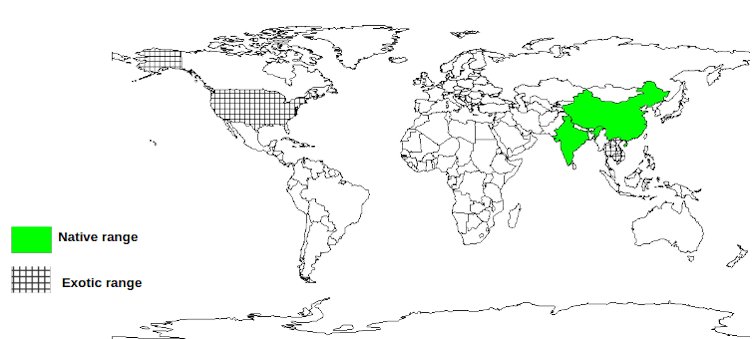
The
map above shows countries where the species has been planted. It does
neither suggest that the species can be planted in every ecological
zone within that country, nor that the species can not be planted in
other countries than those depicted. Since some tree species are
invasive, you need to follow biosafety procedures that apply to your
planting site.
Products
Food:
Longans are much eaten fresh, out-of-hand, but some have maintained
that the fruit is improved by cooking. In China, the majority are
canned in syrup or dried. The canned fruits were regularly shipped from
Shanghai to the United States in the past. Today, they are exported
from Hong Kong and Taiwan. For drying, the fruits are first heated to
shrink the flesh and facilitate peeling of the rind. Then the seeds are
removed and the flesh dried over a slow fire. The dried product is
black, leathery and smoky in flavor and is mainly used to prepare an
infusion drunk for refreshment.
Fuel:
The seeds and the rind are burnt for fuel. The wood is not highly
valued for fuel.
Timber:
While the tree is not often cut for timber, the wood is used for posts,
agricultural implements, furniture and construction. The heartwood is
red, hard, and takes a fine polish.
Alcohol:
A liqueur is made by macerating the longan flesh in alcohol.
Medicine: The flesh
of the fruit is administered as a stomachic, febrifuge and vermifuge,
and is regarded as an antidote for poison. A decoction of the dried
flesh is taken as a tonic and treatment for insomnia and neurasthenic
neurosis. In both North and South Vietnam, the "eye" of the longan seed
is pressed against a snakebite in the belief that it will absorb the
venom. Leaves and flowers are sold in Chinese herb markets but are not
a part of ancient traditional medicine. The leaves contain quercetin
and quercitrin. Dried flowers are exported to Malaysia for medicinal
purposes.
The seeds are administered to counteract heavy sweating and the
pulverized kernel, which contains saponin, tannin and fat, serves as a
styptic.
Other products:
The seeds, because of their saponin content, are used like soapberries (Sapindus saponaria
L.) for shampooing the hair.
Services
Shade or shelter: The longan is cultivated in Bengal and elsewhere as a
shade tree.
Ornamental: The tree is widely cultivated as an ornamental
Tree
Management
A tree can be converted to a preferred cultivar by cutting it
drastically back and veneer-grafting the new shoots. In China, if the
longan is raised on the lowlands it is always put on the edges of
raised beds. On high ground, the trees are placed in pre-enriched holes
on the surface. The trees are fertilized after the fruit harvest and
during the blooming season, at which time the proportion of nitrogen is
reduced. Fresh, rich soil is added around the base of the trees year
after year. The longan needs an adequate supply of water and can even
stand brief flooding, but not prolonged drought. Irrigation is
necessary in dry periods.
Pruning of many flower-bearing twigs where 3/4 of the flower spikes in
the cluster are removed is essential. Later, the fruit clusters are
also thinned, in order to increase the size and quality of the fruits.
In China, full-grown trees given sufficient room–at least 12 m
apart–may yield 180-225 kg in good years. Crops in Florida from trees 6
m tall, have varied from light 22.5-45 kg–to medium–68-113 kg, and
heavy–135-225 kg. Rarely such trees may produce 272-317 kg. Larger
trees have larger crops but if the trees become too tall harvesting is
too difficult, and they should be topped. A serious problem with the
longan is its irregular bearing–often one good year followed by 1 or 2
poor years.
Germplasm
Management
Seeds are recalcitrant. They lose viability at 18 % moisture content.
There is 70 % survival after 7 weeks storage with anesthetic substances
such as moist storage at 8-10 deg C with 100 % relative humidity and
with 80 % nitrous oxide + 20 % oxygen, but no viability when water is
used; and 67 % germination after 250 days moist storage in moist (20 %
moisture content) perlite + 4 % chlorthalonil, at 15 deg C.
Pests and
Diseases
The longan is relatively free of pests and diseases. At times, there
may be signs of mineral deficiency which can be readily corrected by
supplying minor elements in the fertilization program.
Further
Reading
Chen GY and Fu JR. 1989. Deterioration of some recalcitrant seeds.
Plant Physiology Communications. 3:11-14.
Hong TD, Linington S, Ellis RH. 1996. Seed storage behaviour: a
compendium. Handbooks for Genebanks: No. 4. IPGRI.
Huang T, Huang KW, Wang CF. 1996. Five species of eriophyoid mites of
Taiwan (Acarina: Eriophyoidea: Eriophyidae). Plant Protection Bulletin
Taipei. 38(1): 67-74
Morton J. 1987. Longan. p. 259-262. In: Fruits of warm climates. Julia
F. Morton, Miami, FL.
|
|