Article from Specialty Crop Industry
by Donglin Zhang
Developing Tea as a Cash Crop for the Southeast
Tea (Camellia sinensis)
is a native plant to China with more than 3,000 years of cultivation.
Like its cousins, sasanqua and Japanese camellias, tea has been grown
in the continental United States for more than 150 years. But due to
the costs of processing, cultivation and labor, it has never become a
large-scale cash crop.
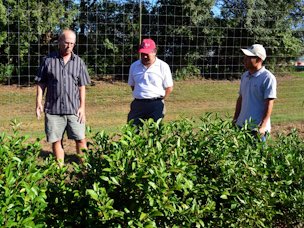 | | University
of Georgia professors Jeff Bennetzen (left) and Donglin Zhang (middle)
discuss tea at the UGA Horticulture Farm with Zhilong Hao (right), a
visiting professor from Fujian Agricultural and Forestry University in
China. |
With growing interest in craft teas
and innovations in breeding and harvesting technologies, now is the
time for Americans to start getting their cups of tea from locally
sourced tea farms. Based on conversations with potential growers across
the southeastern states, the demand for locally grown tea is high.
TEA STATUS IN THE UNITED STATES
Tea
is one of the greatest horticultural crops, serving as both a
beverage/food and beauty product ingredient. Currently, more than 4,000
tea cultivars had been documented for beverage tea production around
the world. However, there are only about 140 cultivars of tea in the
continental United States, and the majority of them are planted as
ornamentals, except at the Charleston Tea Plantation in South Carolina.
The
wholesale value of tea in the United States grew from $1.84 billion in
1990 to $11.5 billion in 2015. Among these figures, 99 percent of the
tea was imported.The most popular tea types are green, red, white,
yellow, brick and oolong. Both tea cultivar and tea processing
determine the tea type and quality. Some special tea types can be sold
for thousands of dollars per pound.
PRODUCTION POTENTIAL
The
southeastern region of the United States shares similar climate and
soil conditions with tea production centers in southeastern Asia. Tea
is a perennial crop that has about 100 years of productivity once
established. Tea growers can harvest tea 15 to 20 times per year. Late
frost damage will not significantly impact tea growers’ income.
The
University of Georgia (UGA) Woody Plant Research Laboratory started to
collect tea plants as ornamental plants six years ago. To date, more
than 100 clones have been propagated and planted at the UGA
Horticulture Farm for further breeding and evaluation. Surprisingly,
tea is growing well in Georgia and other southeastern states. A tea
plant that was brought back from Asia in 1870 and planted in
Reidsville, Georgia, is still growing well.
With support from
the U.S. Department of Agriculture and the Agricultural Ministry of
China in 2016, I, along with four other professors and growers, was
able to explore the Chinese tea industry. Aspects of the industry we
looked at included selection and breeding, propagation, establishment,
harvesting, processing and marketing.The trip made me confident we can
develop tea as a stable cash crop for specialty crop producers in the
Southeast.
RESEARCH GOALS
Developing tea as a specialty cash
crop can be accomplished by utilizing plant breeding efforts to select
new tea cultivars that perform well in the Southeast. The initial UGA
project is focused on selecting the best adapted tea seedlings for
growers and determining the most critical knowledge gaps and barriers
for tea farmers to successfully grow and market tea.
From the
UGA tea collection, researchers will select at least two elite
cultivars for growers. The next step will be to provide tea
reproduction (propagation), cultivation (both nursery and plantation)
and management information to growers to increase their success in
growing the crop.
Tea harvesting and processing are also very
critical for the success of tea farmers. UGA will test the existing tea
processing techniques practiced in the United States (developed by the
University of Hawaii) and in China. The tea components(nutrients and
antioxidant compounds) will be analyzed with emphasis on the uniqueness
of the selected tea cultivars.
A goal is to improve the market
share of tea as a specialty cash crop by providing outreach to
interested growers. Research results on the best practices for growing
and processing tea will be disseminated to current, beginning and
prospective tea farmers and tea lovers. Tea topics to be addressed
include plant regeneration, bed establishment, growing care, pruning,
harvesting, processing and health benefits. Tea growers will have
detailed guidance for establishing their own backyard tea production
beds, which should lead to small-scale tea plantation farms for
commercial production.
In the near future, perhaps our iced tea will come from a local farmer sharing in part of the billion-dollar tea business.
Donglin Zhang is a professor in the Department of Horticulture at the University of Georgia in Athens.
|
|